
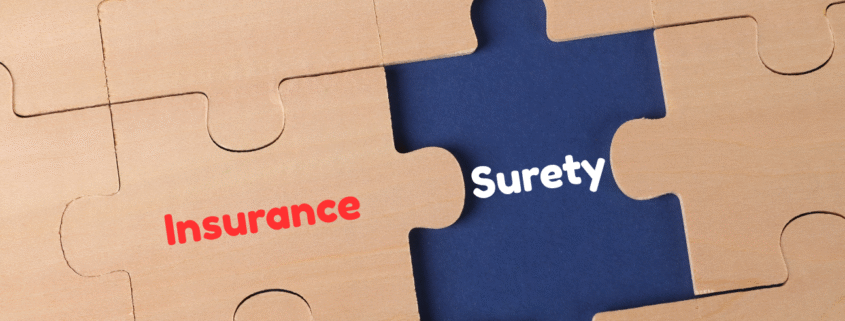
As a leader in the construction or development space, you must proactively manage risk from all angles. You have a commercial insurance agent to handle your liability policies. You have a surety agent to secure your bonds. You review the contracts, check the boxes, and get to work.
But do you ever consider the possible disconnect between your insurance advisor and your surety advisor?
What if your insurance agent doesn’t truly understand surety, and your surety agent has “blinders on” when it comes to the details of your insurance policy?
This lack of integrated expertise in construction insurance and surety is a massive, unmanaged risk for contractors. As mentioned by Insurance Business Mag, commercial contracts have become more complex than ever. And when your advisors work in silos, they create coverage gaps—gaps that could cost you millions.

The “Specialist” Problem: Why No One Is Seeing the Full Picture
The problem isn’t malice; it’s specialization. In our industry, most practitioners focus on either surety or insurance, but rarely both. This creates critical blind spots:
- The Insurance Agent: They are typically sent only the “insurance requirements” page of a contract or a sample certificate. They never see the full indemnity agreement or the project’s operational risks.
- The Surety Agent: They may receive the full contract but often just scan it for bond requirements. They’re not trained to spot how the contract’s indemnity language could trigger exclusions in your general liability policy.
As a result, no one is reading the entire contract with a holistic understanding of how your construction insurance and surety program is supposed to work together.
Gap #1: The Indemnity Clause vs. Your GL Policy
This is one of the most common and dangerous gaps. A contract’s indemnity agreement often begins with the phrase, “To the fullest extent permitted by law…”.
A siloed agent often makes two mistakes here:
- They don’t check the law: They don’t stop to ask, “What is the law in this state?”. An indemnity clause for sole negligence might be completely unenforceable in Kentucky, for example, but fully enforceable in a neighboring state.
- They misunderstand what’s at stake: They assume the indemnity clause only applies to your Commercial General Liability (CGL) policy. But a broad indemnity agreement can pull in other risks, like auto liability, pollution, or professional errors and omissions (E&O)—none of which are covered in a standard GL policy.
Gap #2: The “Faulty Workmanship” Trap
Here is a perfect example of where the insurance and surety silos fail a contractor.
- Fact: Faulty workmanship is a standard exclusion in most CGL policies.
- The Scenario: You’re a General Contractor (GC) and you hire a subcontractor who does faulty work. Your sub’s GL policy will not pay to fix their own bad work.
- The Insurance-only “Solution”: Your (the GC’s) policy might provide coverage for work performed on your behalf, but this will lead to a claim on your GL policy, impacting your premiums and loss history.
- The Better Solution: An advisor with expertise in construction insurance and surety experience would know a contract surety bond solves this problem. If you require the sub to provide a performance bond, you now have a direct path to get the work fixed. You can compel the subcontractor to fix it, or you can hire someone else and have the sub’s surety pay for it.
A bond is often the superior product for this risk, but an agent focused only on insurance may never even present it as a solution.
Gap #3: “Stripped-Down” Coverage and Growing Exclusions
When you and your advisors are hyper-focused on price, you often end up with “stripped-down” coverage. Policies are bought based on a “great title,” but the actual coverage forms are weak. We see this issue consistently across the industry.
This trend is continuing to grow with pollution risk. It used to be common to get some pollution coverage, but policies today increasingly feature “absolute pollution exclusions”. This means a simple incident, like backing a truck into a tank and causing a spill, may be completely excluded unless a specific endorsement is added back to the policy.
A Holistic View: Connecting Your Contracts to Your Coverage
Choosing not to bond a subcontractor because it makes your bid cheaper might win you the job, but it could cost you far more when you’re paying a claim out-of-pocket because your GL policy won’t respond.
At Metropolitan Risk, we built our firm to break down these silos. We believe you cannot advise on surety without understanding insurance, and you can’t build a proper insurance program without reading the full contract. Don’t wait for a claim to discover a gap. Connect with a Risk Advisor today for a comprehensive review of your risk management program.

 Photo by Sam zeng on Unsplash